ISO 594 Test Assembly Machine is Needed for Valid
Test Results.
This issue has many parts which will be addressed individually
ISO 594 Specifies Very Light Torque and Force Requirements.
When the ISO 594 Luer Fitting Standard was designed, the
test method was targeted to replicate the lightest assembly
strength needed to make a leak proof Luer connection. The
torque and force requirements were set at the low end of
the scale so that even a child could assemble the Luer connection
and the seal would hold fast. It is known that as more force
or torque is applied the seal will improve. Testing the
Luer seal at low values automatically validates higher torque
or force values.
ISO 594 Specifies Specific Values which are Verifiable.
When a test piece and reference fitting are assembled,
the force and torque applied to the assembly should be recorded.
Both force and torque are defined in ISO 594 Luer Standard
as maximums and can be measured and shown to not exceed
the ISO 594 required maximum. This is important because
if the test is performed on an assembly that has been assembled
in excess of the maximums, the test is invalid. If assembled
with too much force or torque the probability that the assembly
pass the test is greatly improved.
ISO 594 Requires Simultaneous Application of Both Force
and Torque. ISO 594 is cited below and in each of the citations the
force and torque must be applied at the same time; simultaneously.
Applied separately the force and torque have different results
in the Luer Test Piece/Reference Fitting assembly and will
exhibit different results under test conditions. To assure
compliance with the ISO 594 Luer Standard, and repeatability
of ISO 594 designated test results, the force and torque
must be applied in unison.
Variation in Test Results Create Test Disputes. If there is a contest between two entities about test results;
when the test results are reporting disparate test results;
check for adherence to the ISO 594 Luer Standard requirements.
Assure that torque and force are applied simultaneously.
Assure that the torque and force values are verifiable.
Check to see if one or both parties in the dispute are violating
the ISO 594 Luer Standard requirements. As of the date of
this post, many companies do not use a machine like the
ISO 594 Test Assembly Machine. This holds true for both
manufacturers and testing laboratories. The problem with
that fact is that the test results may be invalid. If invalid
test results were submitted to FDA for approval, the whole
approval process may be flawed. Any test result that exceeds
the limits of the ISO 594 Luer Standard are flawed and worthy
of being questioned.
How to Correctly Make the ISO Luer Test Piece/Reference
Fitting Assembly. The best way to correctly make the ISO Luer Test Piece/Reference
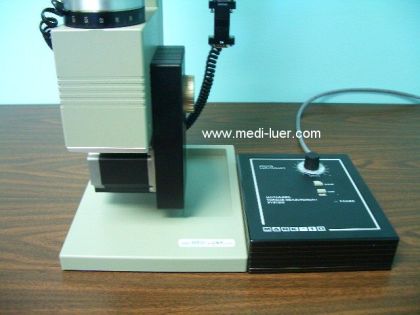
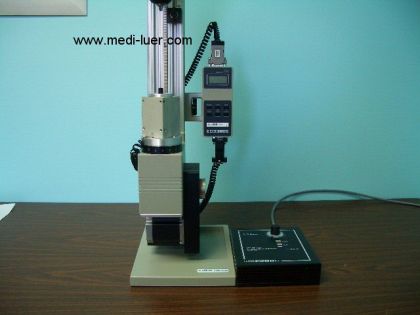
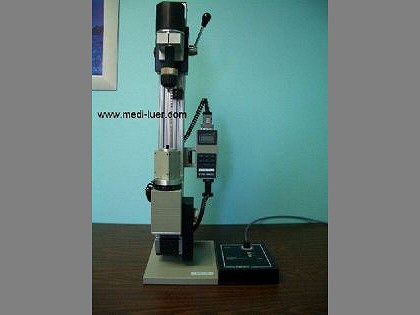
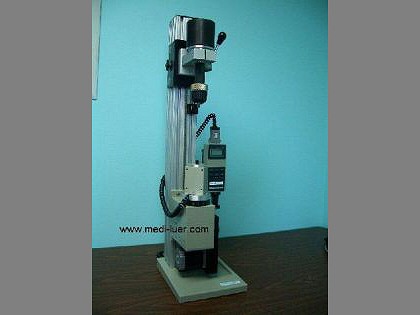
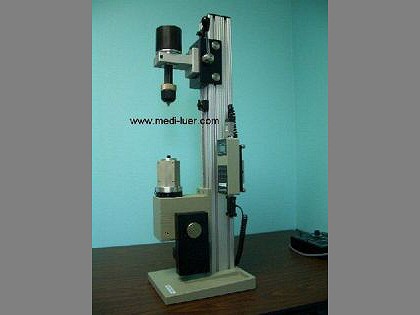
Fitting assembly is to use the ISO 594 Test Assembly Machine.
When used appropriately the ISO 594 Test Assembly Machine
will eliminate the ISO 594 test violations because the ISO
594 Test Assembly Machine is designed specifically to make
the ISO Luer Test Piece/Reference Fitting assembly. What
makes the ISO 594 Test Assembly Machine so special is that
it applies the force and torque simultaneously. This is
a little tricky to accomplish, but the ISO 594 Test Assembly
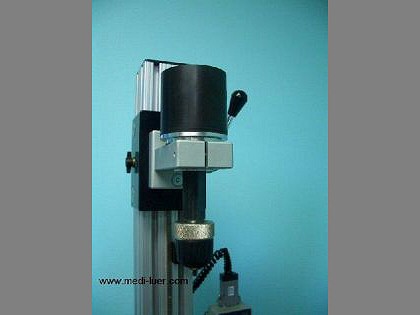
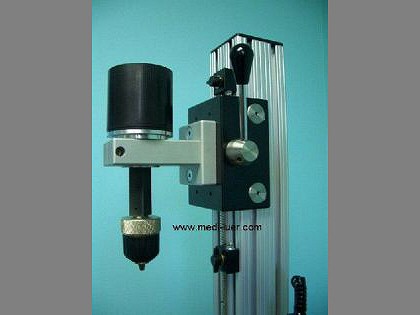
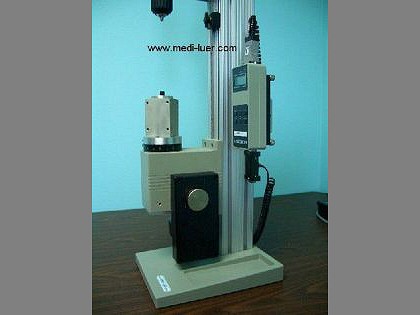
Machine does it well. The ISO 594 Test Assembly Machine
has an automatic stop when the maximum torque is reached
and has an arrangement to assure the maximum force is not
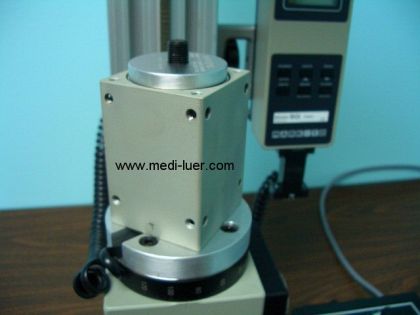
exceeded. The degree wheel on the ISO 594 Test Assembly
Machine is available for monitoring the occasional 90°
maximum rotation specification.
If the requirement is only to have a few pieces tested,
a limited testing requirement, we can make a referral to
a laboratory which will make the ISO Luer Test Piece/Reference
Fitting assembly in full accordance with the ISO 594 Luer
standard.
Citations from ISO 594: Conical fittings with 6%
(Luer) taper for syringes, needles and certain other medical
equipment. This Standard is supplied in two parts:
Part 1: General requirements
Part 2: Lock fittings
ISO 594/1 pp 5.2.1
Assemble the components by applying an axial force of 27.5
N for 5 s whilst applying a twisting action to a value of
torque not exceeding 0.1 N-m to give a rotation not exceeding
90°.
ISO 594/1 pp 5.3.1.1
Apply the male fitting to the female reference fitting with
an axial force of 27.5 N for 5 s whilst applying a twisting
action to a value of torque not exceeding 0.1 N-m to give
a rotation not exceeding 90°.
ISO 594/1 pp 5.5.1
Assemble the components by applying an axial force of 27.5
N for 5 s whilst applying a twisting action to a value of
torque not exceeding 0.1 N-m to give a rotation not exceeding
90°.
ISO 594/1 Annex A.2
Assemble the components by applying an axial force of 27.5
N for 5 s whilst applying a twisting action to a value of
torque not exceeding 0.1 N-m to give a rotation not exceeding
90°.
ISO 594/2 pp 5.2.1
Assemble the fittings by applying an axial force not exceeding
27.5 N while applying a torque not exceeding 0.12 N-m.
ISO 594/2 pp 5.3.2.1
Connect the male fitting to the female reference fitting
by applying an axial force not exceeding 27.5 N while applying
a torque not exceeding 0.12 N-m.
ISO 594/2 pp 5.6
Apply an axial force not exceeding 20 N together with a
torque not exceeding 0.08 N-m.
ISO 594/2 pp 5.8.1
Assemble the fittings by applying an axial force not less
than 27.5 N for 5 s while applying a torque not less than
0.12 N-m.
Gage Crib Worldwide, Inc.
6701 Old 28th St SE, Suite B
Grand Rapids, MI 49546-6937
Phone: 001-616-954-6581 • Fax: 001-616-954-6583 CONTACT FORMS & INFO